
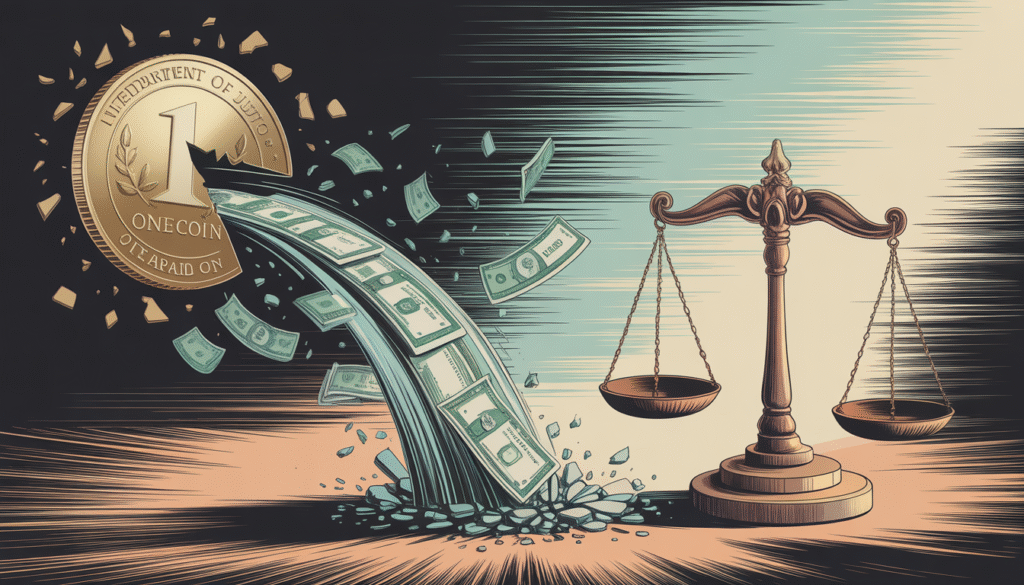
The United States Department of Justice (DOJ) has announced a major step forward in one of the largest financial fraud cases in cryptocurrency history, opening a compensation process for victims of the infamous OneCoin scheme. The move aims to return millions of dollars to investors who were misled by what authorities have described as a global Ponzi-style operation that caused billions in losses.
The initiative represents a rare opportunity for victims to recover at least a portion of their investments, years after the scheme collapsed and its leaders faced criminal prosecution.
A Long-Awaited Path to Recovery
The DOJ confirmed that more than $40 million in forfeited assets is now available to compensate victims of the OneCoin fraud. These funds were seized during investigations and prosecutions tied to the scheme’s operators.
Victims who purchased OneCoin between 2014 and 2019 and suffered net financial losses are eligible to apply for compensation through a formal remission process.
Authorities emphasized that this process is designed to prioritize victims, allowing them to submit claims and potentially recover funds lost in the fraudulent investment. The deadline for submitting claims has been set for June 30, 2026.
Officials acknowledged that while the available funds represent only a fraction of total losses, the program marks an important milestone in delivering justice.
Inside the $4 Billion OneCoin Scam
OneCoin was launched in 2014 by Ruja Ignatova and Karl Sebastian Greenwood, promising to revolutionize the cryptocurrency market and rival established digital assets like Bitcoin.
In reality, the project had no legitimate blockchain technology or real cryptocurrency backing it. Instead, it operated as a global multi-level marketing (MLM) scheme, relying on recruitment and false promises of high returns.
Prosecutors estimate that the scheme defrauded investors of more than $4 billion worldwide, with millions of victims affected across multiple countries.
At its peak, OneCoin was marketed as one of the largest cryptocurrencies in the world. However, investigations later revealed that the coins had no real value or utility, leading to its eventual collapse.
Key Figures and Legal Fallout
The legal aftermath of the OneCoin scandal has been extensive, involving multiple arrests, prosecutions, and international investigations.
Co-founder Karl Sebastian Greenwood was sentenced to 20 years in prison in 2023 for his role in orchestrating the fraud.
Meanwhile, Ruja Ignatova, often referred to as the “Cryptoqueen”remains one of the most wanted fugitives in the world. She disappeared in 2017 and is still being sought by authorities, with a reward offered for information leading to her capture.
Law enforcement agencies, including the FBI and IRS, played key roles in investigating the case and tracing illicit funds. Their efforts led to the seizure of assets now being used for victim compensation.
How the Compensation Process Works
The DOJ’s remission program allows victims to file petitions detailing their losses. Applicants must provide documentation supporting their claims, including evidence of investments and any funds recovered.
Importantly, the process is free to enter. Authorities have warned victims to be cautious of scams or third parties claiming to charge fees for assistance, as no payment is required to participate.
Once submitted, claims will be reviewed by a court-appointed administrator. Payments, if approved, will be distributed from the pool of forfeited assets.
However, officials noted that compensation is not guaranteed. The total funds available are limited compared to the scale of losses, meaning payouts may only cover a portion of individual claims.
A Landmark Case in Crypto Fraud History
The OneCoin scandal is widely regarded as one of the largest financial frauds ever linked to cryptocurrency. Some estimates suggest total global losses could be even higher than $4 billion, with figures reaching up to $19 billion in certain reports.
The case exposed significant vulnerabilities in early cryptocurrency markets, particularly the lack of regulation and the ease with which fraudulent projects could attract investors.
Authorities say the scheme thrived by exploiting hype around digital currencies, using aggressive marketing tactics and promises of extraordinary returns to lure victims.
Broader Implications for Crypto Regulation
The launch of the compensation program comes at a time when cryptocurrency-related fraud continues to rise globally. Law enforcement agencies have reported increasing losses tied to digital asset scams, highlighting the ongoing risks for investors.
Regulators have since tightened oversight of crypto markets, but the OneCoin case remains a cautionary tale about the importance of due diligence and transparency.
Officials say the remission process demonstrates the government’s commitment to pursuing financial crimes and returning funds to victims whenever possible.
A Step Toward Justice, But Not Closure
While the DOJ’s compensation initiative offers hope, it cannot fully undo the financial and emotional damage suffered by millions of victims worldwide.
Many investors lost life savings, retirement funds, and significant personal assets in the scheme. For them, the recovery process represents both a chance for partial restitution and a reminder of the risks associated with unregulated investments.
Still, authorities describe the program as a meaningful step forward. By converting seized criminal assets into compensation, the DOJ aims to ensure that at least some of the stolen money finds its way back to those who were affected.
As the claims process begins, the OneCoin saga continues to serve as one of the most powerful warnings in the history of cryptocurrency- highlighting both the promise of innovation and the dangers of unchecked fraud.