Today, 20th September, marks the International NFT Day, which is a very special day for digital art, blockchain and crypto communities across the world. It’s a moment to reflect on how far Non-Fungible Tokens have progressed, celebrate wins, envision futures and launch something new.
Why September 20th
International NFT Day is celebrated on September 20th because it was the date in 2017 when Dieter Shirley, the Chief Technology Officer of Dapper Labs, first used the term “Non-Fungible Token” and proposed the ERC-721 standard that established the foundation for the current NFT ecosystem. This day is recognized as a global celebration and moment of recognition for the creators, collectors, and communities that have developed around NFTs and the larger Web3 ecosystem.
Origin of NFTs
The origins of NFTs go back nearly a decade before “NFT Day” was officially coined. In 2014, artist Kevin McCoy and entrepreneur Anil Dash created Quantum, a digital artwork registered on the Namecoin blockchain. That was a first-of-its-kind effort to bind a digital image to a blockchain entry, creating a provably unique, transferable digital asset. It planted the seed of the idea: what if digital objects could be as “ownable” as physical ones?
Other innovative projects arose, including Colored Coins on Bitcoin and Counterparty, followed by Rare Pepes to explore ideas of digital scarcity. In 2015, Etheria offered hexagonal tiles of virtual land on Ethereum and contained an early vision of the metaverse. These projects were ingenious but fragmented, lacking a shared standard.
Things changed with Ethereum’s ability to support programmable contracts. In 2017, developers William Entriken, Dieter Shirley, Jacob Evans, and Nastassia Sachs proposed ERC-721, a standard for non-fungible tokens. It also codified the idea of assets with unique IDs, ownership transferability, and metadata links. On September 20, 2017, the proposal became public, and this date serves as an anchor for International NFT Day.
Evolution of NFTs
NFTs did not change the digital landscape in an instant. Their evolution comprises experiments, boom, correction and reinvention.
The Experimentative Years (2014 – 2017)
Prior to specific ERC standards, NFTs were just odd, one-off experiments. Projects like Quantum or Rare Pepes captured unique subcultures, but trading was an ordeal, and marketplaces lacked liquidity. Even though these efforts were ahead of their time, the concepts were too early.
The Standardization Phase (2017 – 2020)
Once ERC-721 was set up, the floodgates opened. In December 2017, CryptoKitties went viral and allowed gamers to buy, breed, and sell animated cats. The game got so popular (at one point, it slowed down Ethereum) that it demonstrated both the promise and limitations of the NFT marketplace. At that time, CryptoPunks were introduced as a collection of 10,000 generative pixel avatars, which became the first cultural references for avatars. Marketplaces like OpenSea began to emerge, offering NFT purists a home.
The Boom (Hype) Cycle (2020 – 2022)
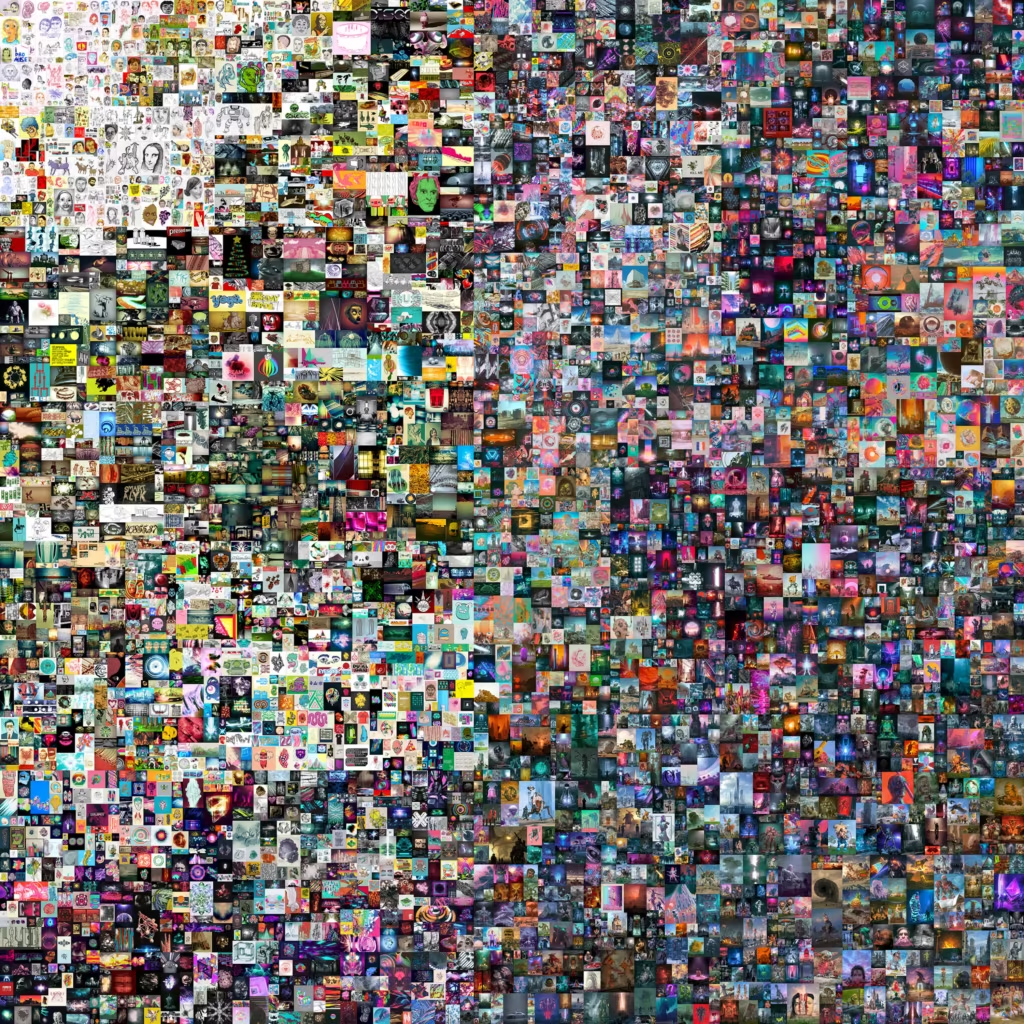
And then came the global tsunami. Celebrities and prominent artists began to actively engage in NFTs. In March 2021, digital artist Beeple sold his work called Everydays: The First 5000 Days at Christie’s for $69 million, a pivotal moment for NFTs in mainstream art. PFP (Profile Picture) collections like Bored Ape Yacht Club became a symbol of status. Brands started experimenting with NFT drops. Investors poured billions into the ecosystem. However, hype also brought scams, speculation, and overheated markets.
Correction and Maturity (2022–2024):
When the speculative bubble cooled, many wrote NFTs off as a fad. Yet beneath the noise, the technology matured. Projects explored NFTs for real utility: game assets, virtual land, access passes, memberships, ticketing, identity, and more. Communities emphasized the permanence of metadata, royalty enforcement, and interoperability. Chains like Polygon, Solana, and Flow gained traction. Sustainability improved as Ethereum transitioned to proof-of-stake.
The Present and Beyond (2024–2025):
NFTs today are beginning to transition from static collectible tokens to dynamic, composable, intelligent assets. Standards like ERC-6551 and ERC-7857 are inviting us toward a new era where NFTs are more than mere tokens but instead active participants in the digital ecosystem; they can own assets, grow and can even embed AI agents. Meanwhile, what began as digital cats and punks has started to evolve into an architecture of identity, governance, and utility for Web 3.0.
NFT Day Observances: Past and Moving Forward
NFT Day has become an international marker of reflection and celebratory immersion into our shared culture. The first celebration of NFT Day began in 2022 when communities began organizing events in the days surrounding September 20th, everything from large conferences to small gatherings, art shows, fabrications, etc.
The year 2022 was presented by Dapper Labs and Flow blockchain, in which they organized global brew-ups in cities such as Berlin, Long Beach and Vancouver. OpenSea and other marketplaces introduced historic NFT collections in the spirit of the day. Many NFT artists created and released special works to mark the occasion as, in some sense, “birthday presents” to the movement.
Museums and auction houses have provided public acknowledgement and forwarding acknowledgments as well. Some created virtual tours that hosted physical installations combined with NFT work to fuse and exhibit some relationship between traditional art spaces and their emergence in Web3. Many online-based communities marked the day by hosting events and experiences such as Twitter Spaces, Discord AMAs, simultaneous drops and collaborations.
For 2025, many of the larger conferences, such as NFT New York City and NFT Taipei, are not necessarily scheduled strictly on the day but are associated with the same cultural event, specifically NFT Taipei 2025, celebrated between 30th November and 3rd December 2025. Meanwhile, the International NFT Day official website lists local and virtual events planned by creators and communities worldwide. Expect a mix of art drops, panel discussions, educational workshops, and Web3 meetups.
New ERC Standards That Will Affect the Future
One of the most fascinating parts of NFT Day was being able to focus on the technical standards. Just like how ERC-721 laid the groundwork for NFTs, new ERC token standards are changing what is possible for them.
ERC-1155: Semi-Fungible Flexibility
First introduced in 2018 by Enjin, ERC-1155 was a standard that allowed a contract to include both fungible and non-fungible tokens. This really opened the door for gaming, where you have fungible tokens, like potions, and non-fungible tokens, like rare swords. ERC-1155 allowed for reduced gas costs and batch transfers.
ERC-6551: Token-Bound Accounts
ERC-6551 was introduced in 2023 and allows NFTs to act as smart contract wallets. With ERC-6551, each NFT is its own account, allowing the NFT to hold tokens, interact with dApps and perform actions. For example, a character NFT would be able to hold weapons, outfits, or currencies directly in itself. ERC-6551 is moving us away from NFTs just being compositions of data and into proposing them to become living digital identities.
ERC-7857: Intelligent NFTs
The ERC-7857 is the most cutting-edge of the new NFT standards, as it defines intelligent NFTs, or iNFTs. Created by 0G Labs, iNFTs are NFTs that have AI embedded into them so the iNFT can evolve, interact with, and transfer intelligence while being securely bound to the NFT. For example, an AI pet NFT could learn from its owner’s past behavior, or an AI assistant NFT could become smarter over a period of time. The metadata can be private, locked, encrypted, and even changed dynamically – a necessity for AI.
Other Proposals: ERC-7007 and Beyond
Community discussions around concepts such as ERC-7007 focus on AI-generated content and provenance. Others are exploring ideas generated through royalties, dynamic metadata, or cross-chain portability. Standards evolve alongside culture: as creators conceptually break new ground, developers work on formalizing using tools for reliability and interoperability.
Why NFT Day is a Chapter Worth Reading
NFT Day can be thought of as more than just nostalgia for “crypto-kitties and pixel punks.” It highlights standards that drive revolutions. If there were no ERC-721, we may not have seen any type of NFT boom at all. By recognizing the day, the community is reinstating the importance of collaboration, shared standards, and continuous reinvention.
Critics and advocates bring attention to concerns such as speculation, rug pulls, environmental concerns and IPR concerns. NFT Day allows the community to witness and contribute to conversations around ethics, sustainability, and inclusion. It reminds us that NFTs are more than about money – they are about the convergence of art, community, and tech.
Every September 20, NFT Day serves as both a birthday celebration and a reflection point. It reflects upon the ERC-721 proposal from 2017, and anticipates the future of intelligent, composable, and functional digital assets. From Quantum to CryptoPunks, from Beeple’s $69 million sale to AI-driven iNFTs, there hasn’t been a linear trajectory of NFTs.
The day serves as an invitation, an invitation to creators, collectors, technologists, and communities. Whether you mint a single artwork, put together a workshop, or simply contemplate the cultural shifts that NFTs have provided to the crypto landscape, NFT Day is another reminder that the future of ownership, identity, and creativity is still being authored.
And arguably that’s the best celebration of all.