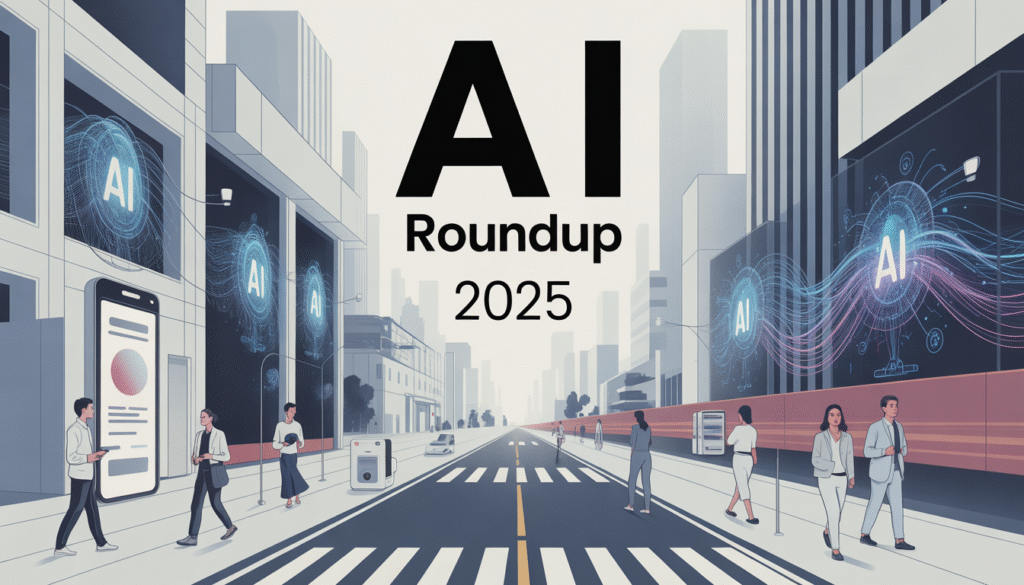
In 2025, Artificial Intelligence (AI) did not arrive with a loud bang. The developments surrounding AI happened with a quiet confidence as if to imply something much more profound than surprise – inevitability.
There wasn’t a single model release that marked the year, or a demo that transformed the collective imagination. Instead, AI finished the kind of transition that will probably count for more when looked back on. Artificial intelligence became the new normal. It blended into everyday existence as it continued to impact and transform at levels that very few technologies ever do.
What electricity was to the industrial society and what the internet was to the information age, AI was set to be to the mid-21st-century world: a general-purpose infrastructure. Not a product. Not a feature. But something that shaped and changed what was possible, what was expected, and what was competitive.
This AI Roundup 2025 article presents an all-encompassing view of AI in 2025, not as hype but as fact. We will be discussing how technology evolved, the impact of such advancements on the work sector, the government’s reaction, the acceleration of science, and the reasons why the questions surrounding AI are undoubtedly human.
The Quiet End of the Model Arms Race
The first two decades saw the adoption of larger models and larger data sets along with more parameters. Each success brewed the promise of something more impressive and intelligent. The early 2020s saw the emphasis on the “scale” front in AI.
However, the story had run its course in 2025.
Despite continued evolution in the models, it became evident that unrefined capability on its own was not acceptable. Intelligence without architecture was deemed unproven, expensive, and unmanageable. Focus shifted from models in academia that existed as single uniphase systems to intelligence systems that resulted in composed, modulatory, and functional systems.
The future of AI was an architectural problem. Players like OpenAI, Google’s DeepMind, and Anthropic independently concurred on the solution: the requirement wasn’t statistical but concerned with control over the input data fed into the AI system’s architecture.
AI systems of 2025 integrated multiple models with elements of memory, plans, tool use, verification levels, and formal mechanisms to enable human review. Instead of reacting to tasks independently, such systems reasoned over time, tasks, and situations. They were able to break down complex tasks to determine their personal work efficacy or escalate ambiguity.
This was a kind of technological adulthood. The point was that AI was no longer assessed for its cleverness but for its predictability, robustness, and accountability. In a way, a system that was marginally weaker but more predictable was preferred over a superior one, which might, in some instances, go awry in a completely unpredictable manner.
Multimodal Intelligence Goes Invisible
One of the most interesting things about the state of AI in 2025 was the rapidity with which the discussion of multimodal capability dropped out of public conversation – not because it had failed, but because it succeeded.
AI systems can automatically process text, images, audio, video, source code, and database information. This meant that activities that required specialized software or human manipulation could now be accomplished from a single environment. The process of writing, analyzing, designing, and displaying became integrated.
It may have started as a verbal concept, evolved into a written proposal, been created into charts, designed graphic illustrations, processed data analyses, or ended as an audio show or functional product. The transition phase was handled by the machine. The human effort was on intention and pointing.
But this reduction of friction led to a surprise in expectations. Speed went up not because people worked so much harder, but because execution costs were reduced. The constraint was no longer manufacturing, but decision-making. It suddenly became crucial to understand what to trust, where to act, and when.
Generative AI and the Normalization of Creation
In 2025, generative AI saw its transformation from an innovation to infrastructure.
Text generation was considered a thing in professional writing. Image synthesis became an integral part of the design process. Video and voice synthesis entered mainstream applications across the marketing, education, and entertainment sectors. Music synthesis, a topic that is culturally controversial, also got mainstream traction in background music, prototyping, and personalization tools.
The most significant shift was neither in quality, where improvements continued, nor in content, where change was substantial, but in expectations. Rough first drafts were no longer precious, while variance was cheap, iteration was incessant.
AI did not end human creativity but rather absorbed its mechanical aspect. As such, humans started to perform roles identified by personal taste, context, ethics, and purpose. The meaning of creative work shifted from execution to intention.
Who made this? was no longer as significant a question as “Who picked this?” The answer to the responsibility moved up, from the maker to the decider.
Enterprise AI Finds a Solid Foundation
While consumer AI influenced the perception of the general public, enterprise AI influenced the shape of the global economy.
In 2025, enterprise-scale organizations were completely invested in AI as an underlying operational tier. Intelligence was mainstreamed in finance, logistics, customer service, compliance, human resources, and internal knowledge management. AI went from proof of concept to basic infrastructure.
Companies such as Microsoft and Amazon pushed this trend even further, with the offer of AI-native platforms fully integrated with the enterprises’ existing software infrastructure. In other words, they rebuilt workflows around intelligence.
And so, budgets for AI research ended up migrating decisively from innovation departments to IT departments. The boards wanted ROI. The auditors wanted transparency, and regulators wanted explainability. Employees wanted to know how AI impacted personnel issues.
This led to the standardization of AI governance across organizations. Ethics committees, model risk management, and audit trails became the norm. Getting to the point where AI was someone else’s experiment became a thing of the past.
Work Transformed at the Level of Tasks
The question of AI and employment loomed large throughout 2025, and the answer proved more complex than either utopian or dystopian predictions suggested.
Jobs did not disappear. Tasks did.
Entry and junior-level routine cognitive labour were most impacted. In addition, tasks increasingly fell to the AI systems: writing, research, basic scheduling, standard coding, and analysis. At the same time, some new responsibilities emerged around supervision, integration, verification, and judgment.
The divide was not between the technical and nontechnical workforce, nor between white-collar and blue-collar jobs. It was between those who learned to collaborate with AI and those who did not.
Workers who could delegate effectively, evaluate outputs critically, and combine domain expertise with AI tools became dramatically more productive. Those who resisted or ignored the shift often found their contributions diminished.
This transformation placed enormous pressure on education and training systems, which struggled to adapt at the same pace. While corporate retraining was expanding rapidly, access remained uneven, especially for small businesses and public institutions.
The Role of Education Reconsidered
Institutions that were forced to undergo a great change in 2025 included education.
As long as the capabilities of AI were such that it could respond to questions in an instant, write an essay smoothly, solve an equation correctly, and tutor each student separately, then traditional methods of assessment lacked validity. Homework assignments, take-home tests, and formulaic essays were no longer relevant measures of understanding.
The reaction of these institutions was experimental. While some focused more on oral exams, offline assessments, and project-based learning, others focused on AI technology, educating their pupils on how to use it.
The most effective strategies viewed AI as an opportunity for literacy skills acquisition rather than a threat. Students were shown methodologies for parsing AI system outputs, verifying the veracity of claims generated by AI, understanding AI output limitations, and detecting bias. The education system underwent a transformation from mere memorization.
This was not an even process, and there were challenges, but it marked the start of something bigger: a shift in what society wants education to deliver.
Regulation Steps Out of the Abstract
For several years, AI regulation occurred only in white papers, proposals, and ethics statements. In 2025, AI regulation became a reality.
The EU’s AI Act is now the most widely followed global regulatory model, establishing risk classifications, transparency requirements, and bans certain AI use cases. Although its enforcement is flawed, it sets a standard for the rest of the world.
Other countries took their own routes. In the United States, a decentralized model was used, with actions taken by the executive branch, guidelines by governmental agencies, and court rulings. China took a centralized approach, with AI development aligned to the state’s agenda.
Regardless of fragmentation, there has been consensus on basic values of accountability, auditable-ness, human oversight, and responsibility. Compliance started to become a design requirement, no longer an afterthought. Trustworthiness turned into strength.
The Geopolitical Means of AI
By 2025, AI was no longer merely an economic technology; it was a strategic one.
Nations were fiercely competing over semiconductor supply chain availability, compute infrastructure, talent flows, and data sovereignty. Export controls had a significant effect on research collaborations. Public-private collaborations increased the availability of AI on national security grounds.
AI impacted productivity, intelligence, cybersecurity, information operations, as well as military logistics. In the growing realignment of global forces, there was a reliance on intelligent systems that could adapt quickly or logically.
In this scenario, AI leadership was equated with sovereignty. Relying on foreign intelligence infrastructure was perceived to be a strategic risk.
Scientific Discovery Enters a New Era
In 2025, one of the most significant but least noticeable effects of artificial intelligence will be in the scientific field.
AI applications hastened discovery in medicine, climate research, materials engineering, genomics, astrophysics, and mathematics. Instead, they assisted scientists in moving away from their reliance on human inquiry by exploring additional hypothesis spaces.
Timelines for drug discovery were reduced. Climate models were refined to a regional level. New materials were discovered through simulation instead of trial and error. Mathematical hypotheses were investigated on scales previously inconceivable.
Scientists began to talk about AI not as a “tool,” but as a “collaborator”- one that could help with the generation of ideas, the recognition of patterns, and the exploration of “conceptual spaces” that would otherwise be inaccessible to the human intellect. The speed of progress sped up. In addition, the nature of the progress shifted.
Creativity, Culture, and the Meaning Question
As AI-generated content flooded cultural spaces in 2025, deeper questions emerged about creativity itself.
If machines could generate endless art, music, writing, and video, what gave human creativity value?
For many creators, the answer lay not in technical execution, but in intent, perspective, and emotional authenticity. Human creativity came to be defined by context, values, and lived experience rather than by output alone.
Copyright law struggled to keep up. Attribution systems remained inconsistent. Cultural norms were renegotiated in real time. Some artists embraced AI as amplification; others rejected it as dilution.
There was no consensus, but there was no return to a pre-AI cultural economy either.
Safety, Alignment, and the Limits of Trust
The discussions on AI safety in 2025 evolved from hypothesizing about human existence to managing risk.
The pressing concerns shifted from hypothetical super intelligence to more mundane errors of hallucinations in critical workflows, automation bias, hidden feedback loops, and reliance on system suggestions.
Due to these challenges, key players have made significant efforts in areas such as system evaluation, red teaming, interpretability, and human override capabilities. Those that were somewhat less capable but more predictable often did better than those that were more capable but less predictable.
Trust was the adoption barrier. Intelligence that was not trustworthy was unimaginable in the business world.
The Question of Human in Focus
By the end of the year 2025, there was no doubt that the conversation of AI had really become less about technology. It was about people.
AI forced societies to grapple with fundamental questions: What kinds of work deserve dignity? How should the gains in productivity be divided? What does accountability look like when decisions are made partly by machines? What abilities count when knowledge becomes ubiquitous?
There were no final answers-only sharper questions and higher stakes.
2025 will not be remembered as the year artificial intelligence amazed us.
It will be remembered as the year it became inescapable.
AI faded into the background even as it reshaped the foreground of human life. It became infrastructure- quiet, powerful, and morally neutral until shaped by human intent.
Artificial intelligence in 2025 is not destiny. It is leverage.
What this era becomes will depend less on algorithms than on the values, institutions, and choices that surround them. And in 2025, that responsibility became impossible to ignore.