
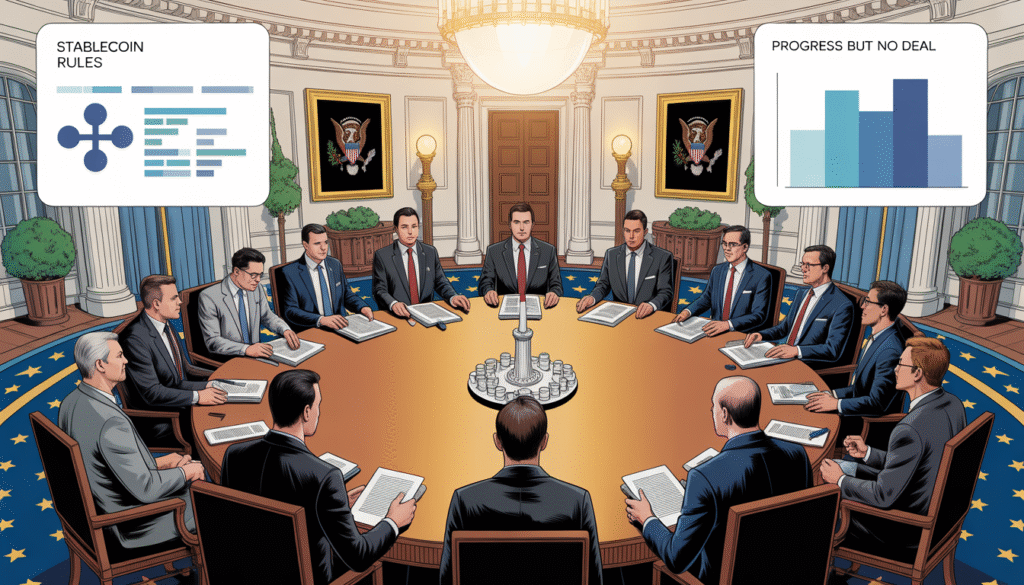
A high-profile meeting at the White House between crypto industry representatives and major banks ended Tuesday without a final deal on key legislation shaping the future of digital assets in the United States. The closed-door session was the second in two weeks focused on forging a compromise over how stablecoins – a fast-growing type of digital dollar-pegged asset – should be regulated in proposed market structure law. Officials described the talks as productive and constructive, but they failed to resolve a bitter dispute over whether stablecoin issuers should be allowed to offer interest-bearing yield or rewards. That unresolved disagreement now stands as one of the main roadblocks to advancing the Senate’s Digital Asset Market Clarity Act – legislation aimed at putting clear, federal rules around crypto trading and stablecoin issuance.
What Was at Stake
Stablecoins, digital tokens usually pegged one-to-one with the U.S. dollar, play a critical role in the crypto markets. They serve as a key on- and off-ramp for traders and act as collateral in lending and decentralized finance.
Banks and regulators are deeply concerned that if crypto firms can offer high yields on stablecoins, it could pull money out of traditional deposit accounts. That could weaken banks’ ability to make loans and threaten financial stability, the bankers argue. Representatives from major financial trade groups like the American Bankers Association, the Bank Policy Institute and the Independent Community Bankers of America attended Tuesday’s session. They brought a written set of “prohibition principles” that would ban any yield on stablecoins, a hard-line stance that surprised some crypto negotiators. Crypto firms, meanwhile, argue that yield programs and rewards are a central tool for attracting users and remain essential for the growth of digital finance. They say limiting or banning yields would stifle competition and innovation.
“Compromise Is in the Air,” But…
Despite the lack of a concrete deal, some participants struck an optimistic tone. Stuart Alderoty, Chief Legal Officer at Ripple, one of the crypto companies present, described the talks as “productive” and said “compromise is in the air.”
Alderoty also stressed that there is continued “clear, bipartisan momentum” behind sensible crypto market structure legislation – suggesting that negotiators still hope to reach a deal in the coming weeks. Industry advocates echoed that sentiment, saying both sides were “engaged in serious problem-solving” during the session. Still, the representatives left without bridging the central divide. Banks pressed for strict limitations on stablecoin yields, while crypto companies sought more flexibility to allow broader use of rewards and interest.
Why the Bill Matters
The stalled negotiations revolve around the Digital Asset Market Clarity Act, a bipartisan bill first passed by the U.S. House of Representatives last year.
Supporters say the law would finally give Americans regulatory certainty over digital assets – an outcome long sought by crypto companies struggling under a patchwork of existing rules. The bill would clarify which federal agencies oversee various types of crypto activity. It has already cleared one Senate committee, but further progress has stalled amid disagreements over stablecoin rules and other provisions. Crypto firms argue that the lack of clear rules is causing U.S. industry leadership to slip while other countries move ahead with defined frameworks that support innovation. Banks, meanwhile, insist that any new law must protect depositors and ensure stablecoins do not undermine the safety and soundness of the financial system.
Broader Political Pressures
The push to resolve the impasse has taken on added political urgency. The White House reportedly urged negotiators to reach a deal by March 1, or risk jeopardizing legislative momentum.
That timeline reflects concern among lawmakers that ongoing delays could scuttle the bill entirely, especially in an election year. Stalled legislation risks running out of time if broad support cannot be built in both parties. Separately, Congressional Democrats have been pushing for additional ethics and oversight provisions related to crypto ventures tied to national political figures, adding another layer of complexity to negotiations.
What Participants Are Saying
Banks left the meeting emphasizing the need for more discussion. In a joint statement, three major banking groups said ongoing dialogue is necessary to “embrace financial innovation without undermining safety and soundness.”
Several crypto industry leaders also took to social media after the meeting to call for continued talks. They urged negotiators on both sides not to “re-litigate” earlier debates around stablecoin policy and to instead focus on finding workable solutions that balance risk with innovation.
What Comes Next
Negotiators are expected to continue discussions in the coming days and weeks, though it is unclear whether there will be another full-scale meeting at the White House ahead of the March 1 deadline.
Both sides say they remain committed to finding common ground. But analysts warn that the fundamental differences over stablecoin yields are not easily resolved, and could continue to block progress if negotiators cannot find creative compromises. For now, the outcome still hangs in the balance. The crypto world remains on edge as Washington grapples with how to regulate one of the fastest-growing corners of modern finance.