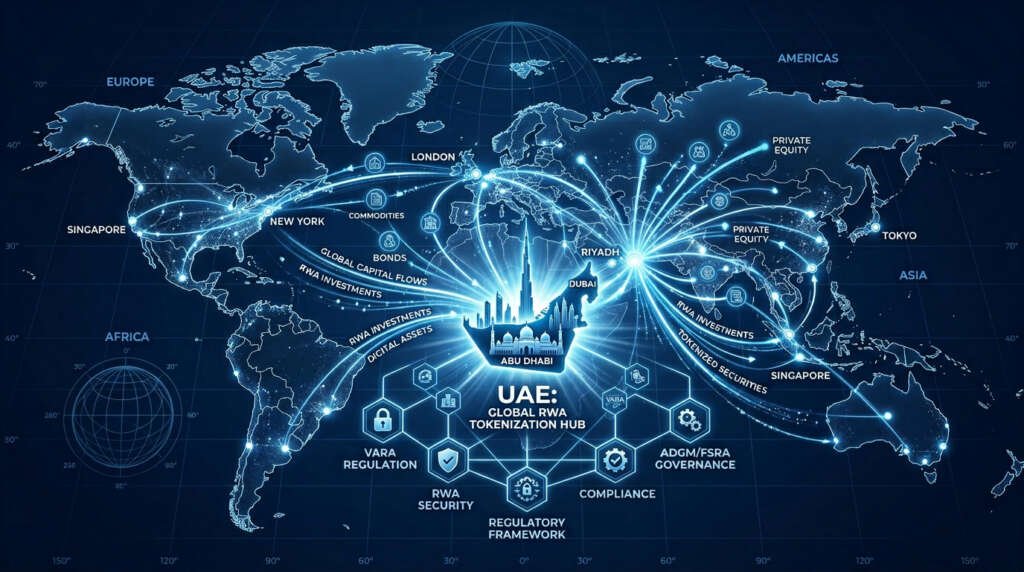
The UAE has become one of the world’s most advanced jurisdictions for Real World Asset (RWA) tokenization with a multi‑layer regulatory system that spans federal authorities, emirate‑level regulators, and common‑law financial free zones.
The UAE has built a regulatory architecture in which tokenized assets are governed by their economic function, legal structure, and underlying asset type. This approach has produced one of the most institutionally mature environments globally for digital asset issuance, safekeeping, and secondary market trading.
Four primary regulators form the backbone of this ecosystem: the Capital Markets Authority (CMA), the Central Bank of the UAE (CBUAE), Dubai’s Virtual Assets Regulatory Authority (VARA), and the financial free zones – the Dubai International Financial Centre (DIFC) and Abu Dhabi Global Market (ADGM). Together, they oversee the full lifecycle of tokenized real‑world assets, from initial structuring and issuance to trading and settlement.
What RWA Tokenization Means in Practice
Tokenizing a real‑world asset means converting ownership rights in a physical or financial asset into digital tokens recorded on a blockchain.
A critical point often misunderstood: tokenization does not change the underlying asset itself. Instead, it transforms how ownership is recorded, transferred, and legally enforced.
In most regulated structures, the asset is placed into a legal wrapper – typically a Special Purpose Vehicle (SPV). Investors then acquire tokenized interests that represent shares or economic rights in that SPV.
This structure unlocks several practical benefits:
- Fractional ownership of high‑value assets (real estate, art, commodities)
- Faster and more efficient transfer of ownership rights
- Programmable distribution of income (rent, dividends, interest)
- Broader investor access to traditionally illiquid markets
However, the real value of tokenization depends not on the token technology itself, but on enforceable legal rights, regulated custody arrangements, and the existence of credible secondary markets.
The UAE’s Multi‑Regulator Framework Explained
The UAE does not have a single unified regime for RWA tokenization. Responsibility is distributed among multiple authorities, depending on the asset classification and the type of activity.
Federal Level – Capital Markets Authority (CMA)
Under Federal Decree by Law Regarding the Regulation of Capital Market, the CMA governs virtual asset activities at the federal level. Its primary focus is on:
- Broker services (dealing as agent)
- Exchange and trading platform operations
- Tokenized securities and commodity contracts
The CMA’s framework establishes clear licensing thresholds, capital requirements, and operational obligations for any intermediary dealing with tokenized assets across all seven emirates.
Central Bank of the UAE (CBUAE)
The Central Bank regulates payment‑focused virtual assets – specifically fiat‑referenced tokens and stablecoin structures. Under the Payment Token Services Regulation (PTSR 2024), only regulated entities may issue or manage payment tokens. Algorithmic or unbacked stablecoin structures are prohibited.
VARA – Dubai’s Virtual Asset Regulator
Within the Emirate of Dubai (excluding the DIFC), VARA regulates Asset‑Referenced Virtual Assets (ARVAs) , which form the core legal category for RWA tokenization.
ARVAs include tokens whose value derives from:
- Real estate
- Commodities (gold, oil, agricultural products)
- Income‑generating assets
- Financial instruments or contractual rights
ARVA issuers must obtain a Category 1 VA Issuance License and comply with strict reserve, custody, and disclosure obligations.
Financial Free Zones – DIFC and ADGM
- DIFC operates a regulatory sandbox through its Innovation Testing License (ITL), allowing firms to experiment with tokenized financial products under controlled conditions.
- ADGM, through its Financial Services Regulatory Authority (FSRA), maintains one of the earliest and most mature frameworks globally for digital securities and tokenized financial instruments.
VARA and the ARVA Tokenization Model
VARA introduced the ARVA classification specifically to regulate tokenized real‑world assets in Dubai.
An ARVA is broadly defined as any virtual asset that represents, or derives its value from, a real‑world asset or income stream. This includes:
- Fractional ownership tokens
- Securitized income rights
- Asset‑backed digital representations
- Wrapped or structured financial exposures
Key Issuer Requirements Under VARA
ARVA issuers face strict regulatory obligations, including:
- Minimum capital: AED 1.5 million or 2% of reserve assets (whichever is higher)
- Segregated custody of underlying assets, held by licensed custodians
- Full legal enforceability – a legally recognized link between the token and the underlying asset
- Mandatory Category 1 issuance license
- Complete whitepaper and risk disclosure obligations
Issuers must also maintain compliance across governance, technology, market conduct, and risk management frameworks.
When an RWA Becomes a Financial Instrument
A critical distinction in the UAE framework is the boundary between general RWAs and tokenized securities.
If the underlying asset qualifies as a financial instrument under UAE law – for example:
- Equity shares
- Bonds or debentures
- Sukuk (Islamic bonds)
- Fund units
- Derivatives
– then the token falls under securities regulation, not purely virtual asset regulation. This can create dual oversight involving both VARA and federal capital markets regulators (the CMA).
Legal classification is therefore a structural and technical issue. It must be addressed at the design stage of any token issuance, not as an afterthought.
The Role of Legal Structuring
Across all regulatory frameworks in the UAE, the Special Purpose Vehicle (SPV) remains the dominant legal structure for RWA tokenization.
The SPV performs three essential functions:
- Holds legal title to the underlying asset
- Issues tokenized representations of ownership or economic rights
- Acts as the contractual bridge between on‑chain tokens and off‑chain assets
In most structures, investors do not own the physical asset directly. Instead, they hold rights in the SPV, and those rights are mirrored through blockchain‑based tokens. This is what enables fractional ownership while maintaining legal enforceability in court.
Key Structural Principles Across the UAE Framework
Despite regulatory variations between jurisdictions (VARA, CMA, DIFC, ADGM), several consistent principles apply to all RWA tokenization structures:
1. Legal enforceability is mandatory
Token holders must have legally recognizable rights tied to the underlying assets
2. Custody must be regulated and segregated
Reserve assets cannot be mixed with the issuer’s own funds. They must be held by a licensed, regulated custodian.
3. Transparency is required at all levels
Whitepapers, disclosures, valuation methodologies, and reserve reports must be publicly accessible.
4. Compliance is continuous, not procedural
Licensing is an ongoing obligation. VARA and other regulators actively supervise, inspect, and enforce post‑licensing.
Beyond the Theory of Tokenization
While RWA tokenization is often described as a revolutionary liquidity innovation, market data shows that structural challenges remain. The key limitations are not technological – they are about market formation:
- Many tokenized assets still suffer from low secondary liquidity
- Investor participation remains limited in private asset classes
- Custody and valuation remain central friction points
As a result, most real‑world implementations today still rely heavily on regulated intermediaries, controlled investor pools, and permissioned trading environments. Fully decentralized, open‑market RWA trading remains more of an aspiration than a reality.
Why the UAE Leads in RWA Tokenization
The UAE’s regulatory framework does not treat RWA tokenization as a separate, experimental innovation layer. Instead, it integrates tokenization directly into existing financial law, ensuring that digital assets remain fully anchored in enforceable legal systems.
However, success in this environment depends on far more than technology. It requires:
- Strong legal structuring (SPVs, trusts, enforceable rights)
- Regulated custody solutions (segregated, licensed, audited)
- Capital adequacy (meeting VARA/CMA minimum requirements)
- Full compliance integration (governance, AML, reporting)
In practice, the UAE model demonstrates that the future of tokenization is not purely decentralized. It is hybrid, regulated, and institutionally governed – a model that balances innovation with investor protection and legal certainty.
FAQs
1. What is RWA tokenization?
RWA tokenization is the process of converting ownership rights in physical or financial assets (real estate, commodities, securities) into digital tokens recorded on a blockchain.
2. Which regulators oversee RWA tokenization in the UAE?
Four main regulators: the Capital Markets Authority (CMA), the Central Bank of the UAE (CBUAE), Dubai’s Virtual Assets Regulatory Authority (VARA), and the financial free zones (DIFC and ADGM).
3. What is an ARVA under VARA’s rules?
An Asset‑Referenced Virtual Asset (ARVA) is a token whose value derives from real‑world assets such as real estate, commodities, income‑generating assets, or financial instruments.
4. Do ARVA issuers need a license in Dubai?
Yes. ARVA issuers must obtain a Category 1 VA Issuance License from VARA and receive prior approval for each token issuance.
5. What is the minimum capital requirement for an ARVA issuer?
The higher of AED 1.5 million or 2% of the average reserve assets over the preceding 24 months.
6. How are tokenized assets legally structured in the UAE?
Typically, through a Special Purpose Vehicle (SPV) that holds legal title to the underlying asset and issues tokenized interests representing shares or economic rights.
7. What is the difference between a general RWA and a tokenized security?
If the underlying asset is a financial instrument (equity, bond, sukuk, fund unit, derivative), the token falls under securities regulation, potentially creating dual oversight by VARA and the CMA.
8. Are algorithmic stablecoins permitted for RWA tokenization?
No. Under the CBUAE’s Payment Token Services Regulation (PTSR 2024), algorithmic or unbacked stablecoin structures are prohibited.
9. What are the main market challenges for RWA tokenization today?
Low secondary liquidity, limited investor participation in private asset classes, and friction points around custody and valuation.
10. Is RWA tokenization in the UAE fully decentralized?
No. The UAE model is hybrid and regulated – it relies on licensed intermediaries, SPVs, and institutional governance rather than pure decentralization.