
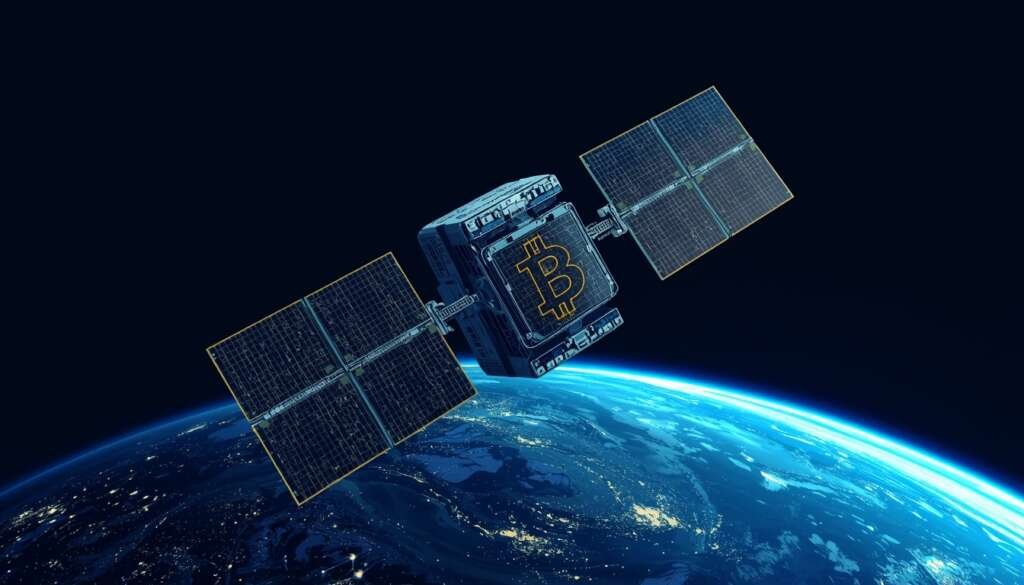
The idea of mining Bitcoin in space may sound like science fiction, but one startup believes it could soon become reality. A U.S.-based company developing orbital data centers has revealed plans to deploy satellites capable of running Bitcoin mining hardware directly in orbit, potentially making it the first organization to mine cryptocurrency beyond Earth.
The proposal reflects a broader push by technology companies to move computing infrastructure into space, where abundant solar energy and extreme cooling conditions could provide advantages over traditional Earth-based data centers. While the concept is still experimental, supporters say it could dramatically reshape the economics of computing and cryptocurrency mining.
A Startup Aiming to Move Data Centers to Orbit
The project is being developed by Starcloud, a startup focused on building large-scale orbital computing infrastructure. The company previously demonstrated that advanced computing hardware could function in space by launching a satellite equipped with a high-performance GPU capable of running artificial intelligence workloads in orbit.
Following that experiment, Starcloud now plans to extend its orbital computing platform to include cryptocurrency mining. The company intends to launch a new satellite mission – often referred to as Starcloud-2 – that will carry specialized Bitcoin mining hardware into low Earth orbit.
If successful, the spacecraft would become the first platform to perform Bitcoin mining operations from space, marking a milestone for both the cryptocurrency and aerospace industries.
Why Space Could Be Ideal for Bitcoin Mining
Bitcoin mining requires enormous amounts of computing power and electricity. On Earth, mining farms consume large quantities of energy and must rely on expensive cooling systems to prevent hardware from overheating.
Orbital environments could potentially solve both problems.
Satellites operating in space can access nearly continuous solar energy, which can be converted into electricity to power onboard computing systems. At the same time, the vacuum of space provides natural cooling, allowing excess heat from mining chips to dissipate more efficiently than on Earth.
In addition to energy and cooling advantages, operating mining hardware in orbit could also avoid some of the limitations faced by ground-based facilities. For example, large mining farms on Earth must contend with land costs, environmental regulations, and community opposition due to noise or energy consumption.
Space-based mining operations would eliminate many of these constraints.
The Technology Behind Orbital Mining
Starcloud’s concept revolves around orbital data centers, which are essentially clusters of satellites equipped with powerful computing hardware. These satellites would perform tasks similar to traditional data centers on Earth but operate entirely in space.
The company has already demonstrated early capabilities. Its first satellite mission successfully deployed a high-performance Nvidia H100 GPU, enabling it to run advanced artificial intelligence models in orbit.
For Bitcoin mining, the startup plans to install Application-Specific Integrated Circuits (ASICs) – specialized chips designed to perform the cryptographic calculations required to validate transactions on the Bitcoin network.
These chips would operate continuously while the satellite receives solar energy, generating the computational power needed to mine Bitcoin blocks.
The Vision of Massive Orbital Data Centers
Starcloud’s ambitions extend far beyond a single satellite mission. The company has reportedly proposed building a constellation of tens of thousands of satellites that would function together as a massive orbital computing infrastructure.
Such a network could host a variety of digital workloads, including:
-
Artificial intelligence training
-
cloud computing services
-
high-performance scientific simulations
-
cryptocurrency mining
Supporters argue that placing data centers in space could reduce pressure on Earth’s power grids and create new opportunities for global computing infrastructure.
The idea is gaining traction as the technology sector searches for ways to meet the enormous energy demands of AI and digital services.
A Growing Interest in Space-Based Computing
Starcloud’s announcement comes amid a broader conversation about building data centers in space.
As artificial intelligence and cloud services expand rapidly, companies are looking for alternative locations to host computing infrastructure. Traditional data centers require massive amounts of electricity and cooling systems, often comparable to the energy consumption of small cities.
Orbital computing could potentially provide a solution by harnessing solar power in space and eliminating many of the cooling challenges faced on Earth.
Several governments and technology companies are already exploring similar concepts, including satellite networks designed for in-orbit processing and edge computing.
Potential Advantages for the Bitcoin Network
If space-based mining becomes viable, it could offer several benefits for the Bitcoin ecosystem.
First, mining in orbit could expand the geographic distribution of mining operations, further decentralizing the network.
Second, using solar energy in space could potentially reduce the environmental impact associated with traditional mining operations.
Finally, operating nodes in orbit might offer faster signal transmission in some scenarios, potentially improving communication within the Bitcoin network.
Some advocates even speculate that space-based infrastructure could one day support a truly interplanetary digital economy, although such ideas remain largely theoretical.
Major Challenges Remain
Despite the excitement surrounding orbital mining, experts caution that significant obstacles must still be overcome.
Launching satellites and computing hardware into space remains extremely expensive. Even with declining launch costs, deploying and maintaining large constellations of computing satellites would require billions of dollars in investment.
Technical challenges also remain.
Mining hardware must be able to withstand radiation, temperature fluctuations, and other harsh conditions in space. Satellite systems must also transmit data back to Earth reliably while maintaining constant communication with the Bitcoin network.
Additionally, space-based infrastructure raises regulatory and sustainability questions, including orbital congestion and space debris risks.
For now, the project remains a proof-of-concept experiment rather than a fully operational mining system.
A Glimpse of the Future of Computing
Even with these challenges, the idea of orbital computing infrastructure is gaining attention across multiple industries.
As launch costs fall and satellite technology advances, the possibility of placing powerful computing resources in space may become more realistic.
For Bitcoin mining, which already operates at the intersection of energy and computing, space could offer a unique environment where power and cooling constraints are dramatically reduced.
Whether Starcloud’s orbital mining experiment succeeds or not, it highlights a growing trend: the expansion of digital infrastructure beyond Earth.
The next generation of data centers may not sit in warehouses or industrial parks—they may orbit hundreds of kilometers above the planet.
If that future arrives, the first Bitcoin mined in space could mark the beginning of a new chapter in both cryptocurrency and space technology.