
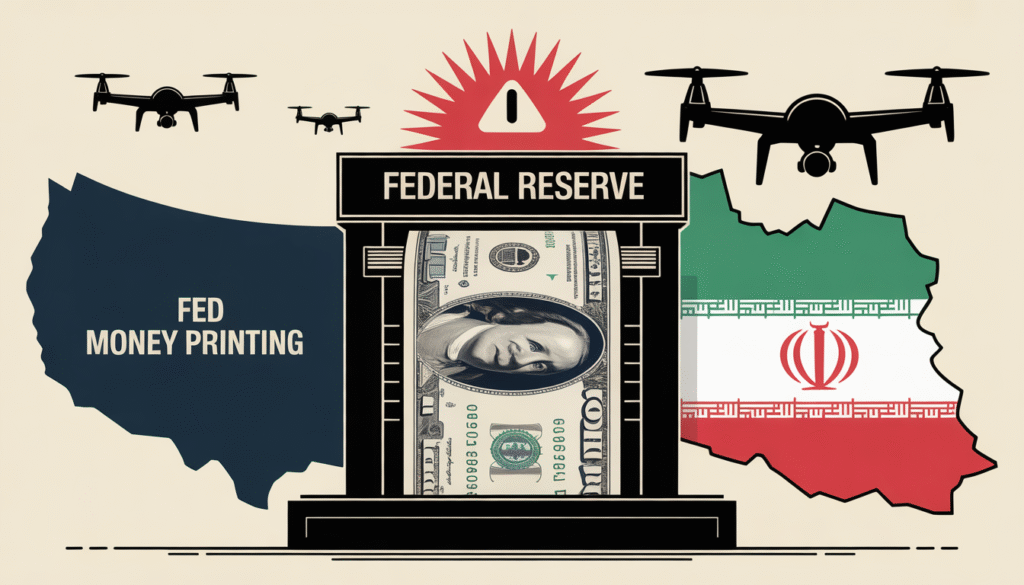
The U.S. Federal Reserve could ease its monetary policy and potentially expand the money supply to support government spending related to a potential prolonged conflict with Iran, according to BitMEX co-founder Arthur Hayes. In a recent analysis, Hayes linked historical patterns of U.S. military engagement and Fed policy decisions, suggesting that renewed or extended hostilities could prompt the central bank to cut interest rates or “print money” – actions that historically have boosted risk assets, including cryptocurrencies such as Bitcoin.
Hayes’ thesis has reverberated through both traditional financial markets and crypto trading communities, triggering active debate over how geopolitical tensions may influence macroeconomic policy, liquidity conditions, and investors’ appetite for risk.
A Historical Pattern of War and Easing
Hayes’ argument centers on the idea that every major U.S. military engagement in the Middle East since the mid-1980s has been followed by monetary easing by the Federal Reserve. He cites key episodes such as the Gulf War in 1990, the post-9/11 wars in Iraq and Afghanistan, and troop surges during the late 2000s as examples where the Fed either cut interest rates sharply or engaged in quantitative easing in the wake of conflict.
In his analysis titled “iOS Warfare,” Hayes suggests that the present conflict involving the United States and Israel’s strikes on Iran – including the killing of Iran’s supreme leader – fits this historical pattern. With President Donald Trump publicly pledging continued military action, Hayes argues that the Fed may eventually feel compelled to loosen policy to fund escalating fiscal costs and temper economic pain.
This linkage between war and monetary policy rests not only on political history but also on the economic realities that large-scale military action can create. Wars often increase government spending dramatically, strain public finances and economic confidence, and affect market stability – factors that have historically pushed central banks toward accommodative policy responses.
The Mechanics: How Would the Fed “Print Money”?
When commentators say the Fed might “print money,” they generally mean that the central bank could increase the money supply through actions such as lowering interest rates, engaging in quantitative easing (QE), or directly purchasing government securities and other assets. Lower borrowing costs and greater liquidity help governments finance large expenditures by keeping borrowing costs lower and encouraging broader spending in the economy.
In the context of war-related spending, critics and market analysts alike debate whether the Fed would shift policy primarily to support military or fiscal objectives. Traditionally, the Fed maintains a dual mandate focused on maximizing employment and stabilizing prices. But in crisis conditions -whether financial downturns or geopolitical shocks – central banks often prioritize liquidity and confidence, even if it means loosening policy in ways that critics might characterize as “money printing.”
Implications for Traditional Markets
The prospect of monetary easing in response to geopolitical tensions has significant implications for broader financial markets. Lower interest rates reduce the appeal of fixed income securities, pushing investors toward higher-return assets such as stocks. Historically, monetary easing has supported equity valuations by making borrowing cheaper and increasing liquidity in financial systems.
In recent trading, renewed conflict and uncertainty pushed U.S. stock futures slightly lower, while major indices like the S&P 500 reflected modest declines in early trading. Broader market reactions to geopolitical headlines often include flight-to-safety behavior initially, followed by repositioning once central bank intentions become clearer.
In addition, currency markets typically reflect shifts in risk sentiment and monetary expectations. Safe-haven assets like the U.S. dollar often strengthen in times of heightened geopolitical uncertainty, while higher-risk currencies weaken. Other commodities such as gold and oil also react to conflict-related supply concerns and safe-haven demand.
Crypto Markets: Liquidity, Bitcoin, and Risk Sentiment
Hayes’ thesis has drawn particularly strong interest from the cryptocurrency community. His view implies that an imminent or prolonged conflict – and a subsequent Fed policy pivot – could create favorable conditions for risk assets, including Bitcoin (BTC). According to market data, Bitcoin was trading around $66,200, down roughly 30-47% from its all-time highs in late 2025. Despite the downturn, some traders and analysts see potential for upside if monetary policy loosens.
Cryptocurrencies are often viewed as highly liquid, risk-sensitive assets. In periods of monetary expansion, increased liquidity tends to push investors toward assets with higher expected returns. Hayes has suggested that waiting for actual policy easing – such as a rate cut or explicit increase in money supply – may be the optimal time to add exposure to Bitcoin and quality altcoins.
Interestingly, crypto markets have also shown resilience amid geopolitical volatility. Researchers and analysts note that while near-term price movements can be choppy, structural narratives around digital assets – including institutional adoption, broader infrastructure development, and long-term liquidity flows – remain intact despite short-term selling pressure.
Wait-and-See: Hayes’ Recommended Strategy
Despite his long-term bullish macro outlook tied to monetary easing, Hayes himself urges caution in the near term. He acknowledges that it remains unclear how long the U.S. will sustain military engagement or how much financial market disruption policymakers are willing to tolerate before pivoting. As a result, his recommendation to investors is to wait for clear Fed action rather than pre-emptively positioning ahead of potential easing.
This approach reflects a broader strategic sentiment among seasoned macro investors: markets tend to price in expected policy moves before they happen. Buying into assets like Bitcoin too early, ahead of actual monetary easing, carries significant risk if the anticipated policy shift does not materialize or is delayed.
Geopolitical Context and Market Psychology
Geopolitical tensions involving the U.S., Israel, and Iran have triggered increased volatility across financial markets. Social-media metrics from crypto analytics platforms showed spikes in mentions of “World War 3,” although overall sentiment remains below the levels seen during previous escalations, such as mid-2025.
Sentiment is a key driver in both traditional and crypto markets. When fear and uncertainty rise, investors often seek safe havens such as government debt, gold, or even the U.S. dollar. Over time, if markets receive signals of liquidity support from central banks, risk assets – including equities and cryptocurrencies – often regain momentum.
The Broader Takeaway: Liquidity Meets Geopolitics
Hayes’ thesis highlights a broader intersection of monetary policy, geopolitical risk, and investor behavior. While the Federal Reserve is institutionally independent and focused on macroeconomic stability, historical patterns show it has adjusted policy in response to severe shocks, including geopolitical ones, to support broader economic confidence.
For investors in both traditional and crypto markets, understanding the potential linkages between geopolitical developments and monetary policy can help frame risk and opportunity. However, history also shows that market dynamics are rarely predictable with precision. Monetary policy responses are influenced by inflationary pressures, employment data, fiscal conditions, and global economic trends – not solely by geopolitical events.
Final Thoughts
The possibility of the Federal Reserve cutting rates or expanding the money supply in response to U.S. involvement in Iran remains speculative – yet it is grounded in observed patterns from past conflicts. Traders and investors now face a complex backdrop where macroeconomic policy, geopolitical risk, and liquidity expectations intersect.
For traditional markets, policymakers’ actions could help stabilize risk assets and ease funding pressures. For crypto markets, any policy pivot that boosts liquidity and risk appetite could act as a catalyst for renewed interest in digital assets.
Caution and timing, however, remain essential. Waiting for explicit policy moves – rather than betting solely on expectations – remains a recommended strategy for investors weighing the impact of geopolitical events on markets.